The branch maintenance checklist: what to audit every month
A practical monthly branch maintenance checklist for banks: what to check in each area, how to score it the same way everywhere, and how to make findings get fixed.
15 November 2026 · 5 min read · Chirag Sharma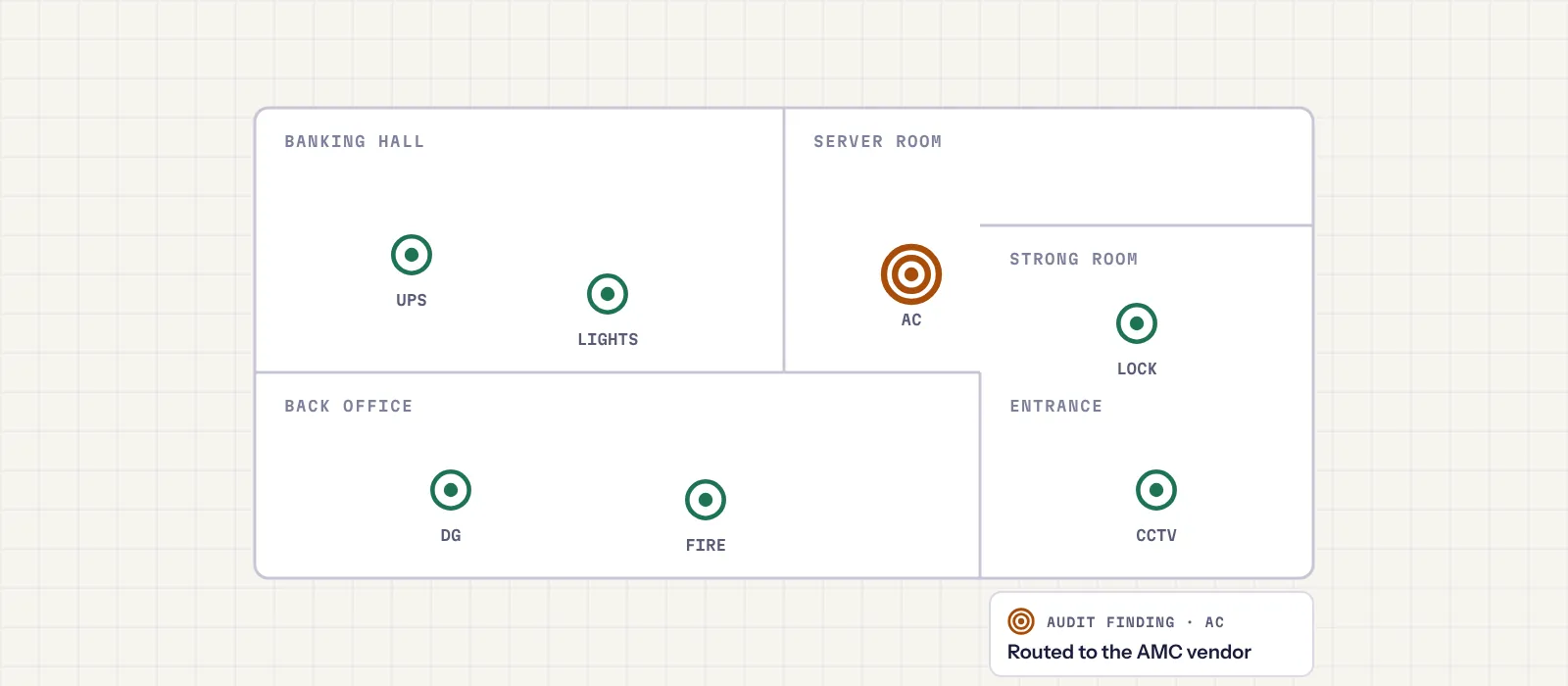
Most banks already audit their branches. The trouble is what happens around the audit. Every region uses its own version of the checklist, scores are hard to compare, the photos sit in someone's phone, and findings go into a spreadsheet that nobody checks until the next visit finds the same leaking AC.
This post is for corporate real-estate, admin and operations heads who look after dozens or hundreds of branches. It gives a monthly checklist you can adapt, then covers the part that matters more than the list itself: running it so that the scores mean something and the findings get fixed.
Why a monthly branch audit is worth the effort
A branch fails in small ways long before it fails in big ones. A UPS battery that is getting weak, a fire extinguisher past its refill date or a damp patch above the server room are cheap to fix when someone sees them, and expensive when they turn into an outage, a failed inspection or a closed branch. A monthly walk-through catches them while they are still small.
It also gives head office something it rarely has: a like-for-like view of every branch's condition. That only works if every branch is checked against the same list, scored the same way and backed by evidence.
The monthly checklist, area by area
Use this as a starting point and adjust it to your branch formats, your bank's own safety and security policies and your AMC contracts. Keep each check something a person can answer with a yes or no and prove with a photo.
Safety and fire
- Fire extinguishers in place, accessible, with a valid refill date and pressure in the green.
- Fire alarm panel showing normal, with no faults or silenced zones.
- Emergency lights and exit signs working; exit routes clear of boxes and furniture.
- First-aid kit stocked and in date.
Power and backup
- UPS running without alarms; battery condition as per the last AMC report.
- Generator (if fitted) test-run logged, fuel level recorded.
- Distribution board closed and labelled, no loose or temporary wiring.
Cooling and the server room
- Server room AC running, temperature within your bank's range, no water leaks or ice on the unit.
- Banking hall ACs cooling properly; filters cleaned on schedule.
- Server room clean, locked and not being used as a store.
Security systems
- All CCTV cameras recording, with footage kept for the period your policy requires.
- Intruder and panic alarms tested and reporting to the monitoring point.
- Strong room and locker room doors, locks and time locks working.
Customer areas
- Banking hall clean, well lit and with every light working.
- Signage, notice boards and required displays in place and readable.
- Queue system, seating, drinking water and washrooms working and clean.
- Ramp and entrance usable for customers with limited mobility.
- If the branch has an ATM lobby: lighting, door access, cleanliness and the machine's condition. (ATM faults usually go to a separate team; see ATM field service.)
Building and housekeeping
- No seepage, leaks or damp patches on ceilings and walls.
- Pest control done on schedule, with the vendor's record.
- Housekeeping checklist signed for the month; back office and pantry clean.
- Furniture, doors and windows in working order.
Make the scores comparable
A checklist only helps head office if a score of 85 in one region means the same as 85 in another. Four rules make that happen:
- One template for every branch. Regions can add checks, but the core list and its scoring stay the same everywhere.
- A photo for every check that can have one. An auditor marking "fire extinguisher OK" should show the refill tag. A photo taken at the branch, at the time of the audit, is what lets anyone trust the score later.
- Weight what matters. A missing extinguisher is not the same as a faded poster. Give safety and security checks more weight, and mark a few as critical so that failing one flags the branch however good the rest looks.
- Rotate or spot-check auditors. The same person auditing the same branch every month tends to see what they expect. Have regional teams check a sample of each other's audits against the photos.
Turn findings into fixes
An audit that finds problems but doesn't get them fixed only builds a record of what was ignored. Every finding should leave the audit with an owner, a deadline and a way to prove it was closed.
- FindAuditor fails a check and takes a photoProof captured on site
- RaiseA ticket is opened against the assetNo retyping into a sheet
- RouteSent to the vendor under that asset's AMCWith the contract's SLA
- FixVendor repairs it and uploads after photosBranch signs off
- ReviewClosed finding counts in the next scoreRepeats are visible
Three habits keep this working:
- Link findings to assets, not just branches. "AC leaking" is a note. "Server room AC #2, under AMC with vendor X" is a job someone can be held to, and it builds the asset's history.
- Follow up before the next audit, not at it. If a vendor hasn't given a date within a day or two, someone should be asking. Waiting a month to discover nothing happened is the most common failure.
- Track repeat findings. The same fault appearing at the same branch three months in a row points to a vendor, a contract or an asset that needs replacing, not another reminder.
Read the results every month
Once audits run the same way everywhere, the monthly review gets much more useful. Look at:
- Branch scores by region, and which branches moved most since last month.
- Critical failures still open, and for how long.
- Average time from finding to fix, by vendor.
- Repeat findings by asset type, which often shows where AMC terms or equipment need a rethink.
- Audits not done on time, because a branch that isn't audited has no score at all.
Where Fieldor fits
Fieldor runs this whole loop for branch estates. Audit templates and scoring are configurable, with required photos per check, so every branch is scored the same way and each score can be traced to the photos behind it. Every asset is QR-tagged by branch and area, with its AMC and PM schedule and reminders before anything falls due. Each audit finding is raised automatically as a ticket and routed to the vendor under that asset's AMC with its SLA; ChasePilot chases the vendor for an ETA and EmailPilot logs their email replies against the ticket. Technicians check in on the branch geofence and close with before and after photos, and the monthly review, with PM compliance and SLA by vendor and zone, is built from the same data. See how Fieldor works for bank branches, or book a walkthrough.

Driving excellence for the maintenance champions who keep ATMs, branches and facilities running, with field work they can see, measure and prove.
Chirag on LinkedIn